Your clicks are up. Your sales aren’t. Before you blame the ads, consider an uglier possibility: click fraud. Someone — a competitor draining your budget, or bots doing it at scale — is clicking your ads on purpose. It happens more than Google wants you to think.
Here’s how to figure out what’s really going on, and how to stop click fraud for good.
Step one: check the humans before you hunt for click fraud
When you run ads, it’s vital to check bounce rate and how long people stick around on your site. Not just to fine-tune targeting — as a diagnostic.
If they aren’t sticking around, they obviously aren’t your ideal customer. Something in the messaging needs to change. They liked the ad enough to click. So what’s not working on the other side of that click?
Typically we’d branch off and test both. Keep one version the same and change the targeting. Keep the other the same and change the messaging on the landing page. That tells you whether the problem is who you’re reaching or what you’re saying.
Rule out the human problem first. Then look for the click fraud problem.
The signs of click fraud
Once you’ve confirmed real visitors would actually convert, look for the patterns that scream click fraud. Clicks spike with no lift in real engagement. Traffic comes from places you don’t serve. The same IPs or devices click over and over. Spend climbs while genuine inquiries stay flat.
Here’s the reality. You’d think Google would be honest about click fraud. They aren’t — at least not in any way that helps you.
You can report invalid clicks. Google may acknowledge some of them. But the majority of the time, you’re lucky to get a penny back. Literally. Google makes money when ads get clicked — including the fraudulent ones. Their incentive to aggressively police click fraud is exactly as strong as you’d expect.
The fix: click fraud prevention tools
This is why tools like ClickCease exist. They monitor your traffic in real time, identify bots and bad actors, and block them before they burn more of your budget.
And I can tell you this from experience: we have yet to install it for a client and not see a return on the cost — just from the amount of click fraud it stops alone. Whether it’s a bot network or a competitor, the blocked spend pays for the tool. Every time.
What to do this week to stop click fraud
First, look at your bounce rate and time on site. Run the targeting-versus-messaging test. If the humans check out and the numbers still don’t add up, stop assuming your ads are the problem. Assume someone is committing click fraud against you, and put protection in place. Your ad budget should go to customers, not competitors.
Suspect click fraud in your account? Book a fit call and we’ll look at what’s really happening.
If you’re trying to decide between Google Ads and SEO, you’ve probably heard confident answers in both directions. The ads people tell you SEO takes too long. The SEO people tell you ads are a money pit. This one gets controversial depending on who you ask — so here’s where I land.
Don’t pick one. Cast a wide net and do a little of everything, consistently. That’s the best path to eating an elephant — not going all in on one thing.
What Google Ads actually does for you
Google Ads gets you there short term, and it costs more. That’s the trade. You pay for placement, you show up now, and the leads start coming in while everything else is still ramping up.
But here’s the part most businesses miss: you should keep ads running at a small capacity even after SEO starts working. Not as your main engine — as insurance. A competitor can outspend you overnight. An algorithm change can wipe out your organic visibility. That can and will happen. When it does, the businesses with ads still humming at a low level keep getting leads while everyone else scrambles.
What SEO actually does for you
SEO is the foundation. It’s the slow, consistent build that lets you show up organically — without paying for every single click.
And here’s the warning: if you never build it, you’re going to keep paying and paying. The market gets more saturated over time. Clicks get harder to win. They get more expensive. Every year you skip SEO, the paid route costs you more than it did the year before. SEO is how you stop renting all of your traffic.
The fail-safe principle
If you go all in on one and ignore the other, you don’t have a fail-safe. Ads-only means one algorithm update or one aggressive competitor can cut off your leads completely. SEO-only means you’re waiting months for traction with nothing coming in the door right now.
A little of everything, consistently, means neither one can sink you on its own.
The biggest mistake with Google Ads (it’s not what you’d expect)
The gut answer is hiring the wrong agency — the one that turns a few ads on and never looks at them again. That happens, and it’s bad. But it’s not the biggest mistake.
The biggest mistake is trusting what Google suggests you do.
Inside the platform, Google serves up recommendations that feel like they’re the best thing to do. Increase your spend. Change redundant keywords. Add negative keywords. It presents them like expert advice. But Google doesn’t fully understand your audience, your demographic, or your ideal customer — and Google makes money when you spend more, not when you convert better.
I can’t tell you how many times clients have logged in, accepted all the suggestions, and then called me in a panic. Suddenly they’re targeting customers outside the United States. Their cost per click tripled. Google is claiming conversions — but when you check the actual data, it didn’t drive a single new sale.
Google’s suggestions are built to increase Google’s revenue. Treat them that way.
The biggest lie in SEO
Then there’s the other side. Companies claiming “rank #1 or your money back.”
They’re either lying, or they’re ranking you for a keyword no one is actually using or searching for. Nobody can guarantee you’ll outrank the competition. Nobody can guarantee the speed. They aren’t magic 8-ball readers.
Here’s what an honest SEO can actually tell you: their plan for doing it. What tools they use. What blogs they’ll write. The keyword difficulty of each target. The content strategy to rank. If someone can’t show you that and instead just promises you the top spot, walk away.
So which first?
Both — weighted by where you are right now. If you need leads this month, Google Ads carries the short term while SEO builds underneath it. As organic starts compounding, you trim ad spend back to that small, steady insurance layer instead of killing it completely.
The businesses that win long term aren’t the ones that picked the “right” channel. They’re the ones that never depended on just one.
Want someone to look at your full picture — ads, organic, and everything around them — before you spend another dollar? Book a fit call.
You’re about to pay someone with 200k followers to post about your brand, the follower count looks impressive, the media kit looks impressive, everything seems safe. then the post goes live, the likes roll in — and nothing happens. No traffic. No sales. Nothing.
You’ve just paid for an audience that doesn’t exist.
This happens constantly. Research puts fake followers at over a third of influencer audiences — and the accounts brands buy most, in the 100K to 500K range, are the worst for it.
Clients come to us after this has happened to them. Or they’re hesitant when influencer marketing comes up in their strategy — because they’ve been burned before.
You’re not alone: an estimated $4.6 billion is wasted on influencer fraud every year. It happens to the best of brands.
Here’s how we make sure it doesn’t happen again.
We’ve been on both sides since 2014
We’ve been managing influencers for our clients since 2014 — before most people even knew what an influencer was. We’ve done EGC content and trade deals, and we understand both sides of it: hiring influencers for brands, and managing the personal brands that are influencers themselves.
That means we know what influencers are looking for in a deal, what type of content actually converts, and how to spot a fake from either side of the table.
If you’re an influencer, read this
Not every fake influencer is a scammer. A lot of them fell victim to buying likes because they didn’t know better — they were told the likes were real.
We had a client come to us who swore the likes they’d bought were real people. We had to tell them they weren’t, and we had to clean it up for them — because it hurts the algorithm. A lot of influencers do it once, thinking it’s an investment. But long-term, it damages the account. They started with good numbers, fell victim to it, and never had a cleanup crew come back in and remove all those inactive followers.
So it’s not always intentional. But it still means they’re not a good fit for a brand deal — and if it’s your account, it’s worth fixing before it costs you real partnerships.
Here’s the truth brands are starting to understand: it’s better to work with a micro-influencer whose audience is authentically engaging, commenting, and purchasing than a 2-million-follower account whose audience just isn’t engaged. Smaller and real beats bigger and hollow, every time.
The red flags we check first
Forget the follower count. Here’s what actually tells you the truth:
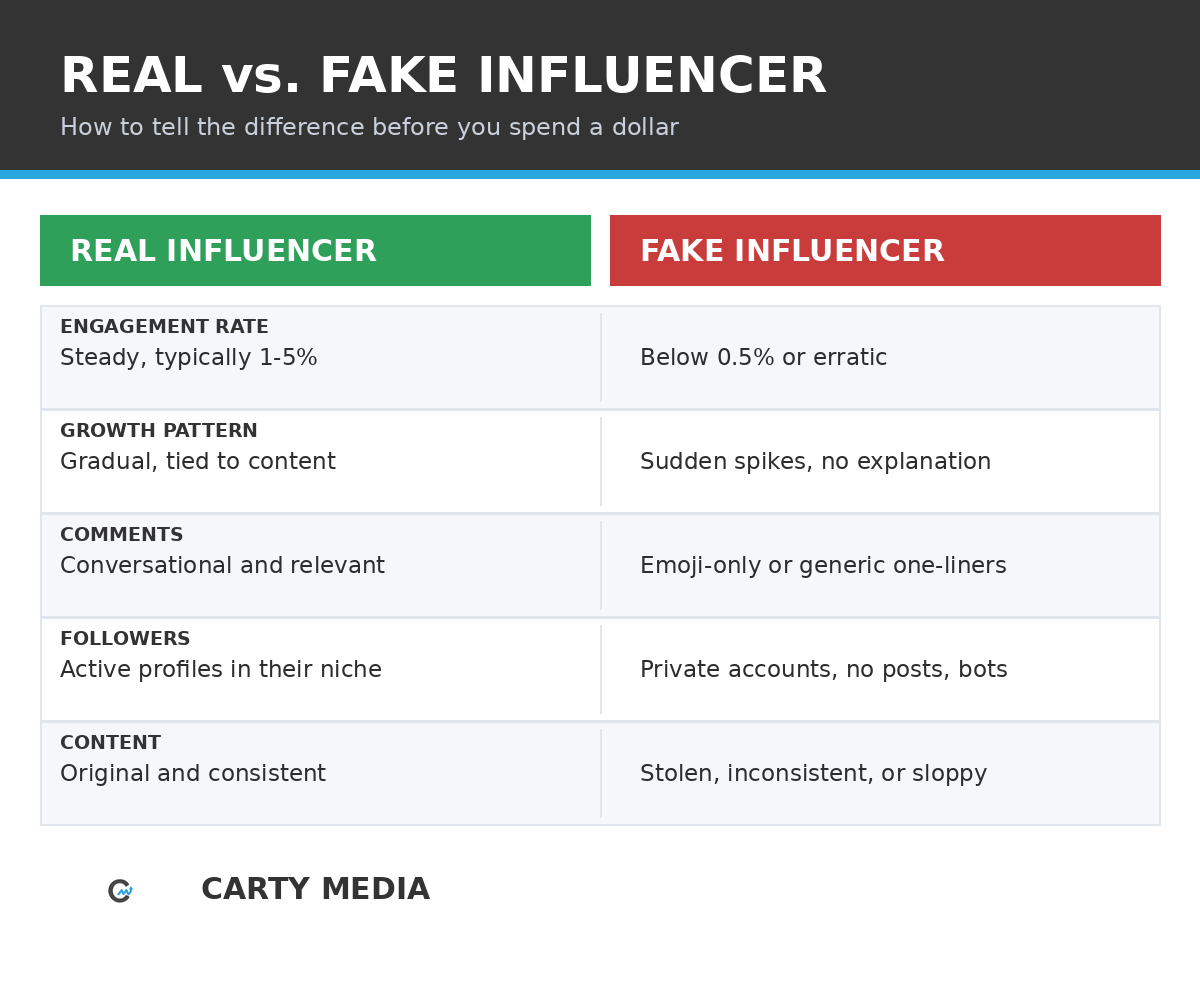
High followers, low engagement. The classic mismatch. Hundreds of thousands of followers and a few hundred likes per post? That audience isn’t real — or isn’t paying attention, which amounts to the same thing.
Click into the followers. This is the check most people skip. Scroll through who’s actually following them. A lot of private accounts with no posts. Accounts with little to no posts at all. If the follower list looks like a graveyard of empty profiles, you’re looking at purchased followers.
High engagement, no real comments. This one’s sneakier. The like count looks healthy — but read the comments. No authentic conversation. No long comments. Just short emojis, or comments that are all a couple of words with similar themes. Real audiences talk. Bot audiences decorate.
The screenshot trick
Here’s something most brands don’t know: it’s easy for an influencer to post a screenshot of one campaign they threw money at — or one where they went and bought the likes and comments. Yes, you can buy those.
But they aren’t doing it on every post.
That’s why you can’t judge an influencer by their best post or their media kit. Look at the pattern across all their posts. One post with 10,000 likes surrounded by posts with 400 likes isn’t a viral hit — it’s a purchased one. Using a tool that spots this pattern for you is key, because the human eye misses what the data catches.
Real vs. fake: the comparison
Tools that check for you
Manual checks catch a lot. But the right platform catches what you can’t see — audience quality scores, fraud patterns across every post, bot networks. These are the tools worth knowing:
HypeAuditor. Audience quality scoring, follower authenticity breakdowns, engagement authenticity metrics. The standard for deep vetting.
Modash. Fake follower detection with a fraud score built on growth velocity — built to catch the sudden spikes that signal purchased followers.
Social Blade. Free growth-trend tracking. The fastest way to see whether an account grew organically or in suspicious jumps.
Heepsy. Follower location and audience analysis — useful when the audience geography doesn’t match the influencer’s market.
How we vet influencers for clients
Our process is simple: the tool runs first, our eyes run second. The platform flags the audience quality, the fraud patterns, the engagement consistency across every post — the things no screenshot can fake. Then we do the manual checks above: the follower list, the comment quality, the pattern across posts.
An influencer who’s real passes both. An influencer who’s faking it almost never does.
You’ve likely heard of AEO by now — or you’ve noticed something changing and you don’t have a name for it yet.
Your customers are using ChatGPT to get answers. They’re seeing Google’s AI Overview at the top of their searches instead of clicking through to websites. And if you’re watching your traffic, you’ve probably felt it: the rules you learned for SEO aren’t delivering the way they used to. You’re not sure how to show up in the results anymore — because the results themselves have changed.
That’s what AEO is about. Answer engine optimization is how your brand becomes the source an AI cites when it answers a question. Not ranking in a list of ten blue links — being named in the answer itself.
If you know SEO, you already understand half of it. SEO gets your website to rank in Google’s results. AEO gets your brand cited when an AI gives the answer instead. Same goal — visibility — on a different surface.
Everything in this article is measured with real tools — the same platforms we use for clients, starting with SEMrush. You’ll see them, with screenshots, below.
Tools for AI Search Results
Here’s the part most articles skip, and it’s the most important one. Without the right tools installed, you have no idea whether any of this work is actually working. You need to see it — which pages are being cited, how much traffic AI is sending, and where that traffic goes next.
Start with the free tools, which you should already have:
Google Analytics 4. Go to Acquisition, then Traffic Acquisition, and add session source as a dimension. You’ll see referrals from chatgpt.com, perplexity.ai, and the other AI engines. Set up a dedicated AI channel so that traffic is tracked separately from regular referrals — then you can see AI visits, which pages they land on, and whether they convert.
Google Search Console. Watch which queries are triggering AI summaries and how your pages perform on them.
Bing Webmaster Tools. ChatGPT pulls current web content through Bing’s index, so your Bing visibility directly affects whether ChatGPT can find you.
Those tell you what happened. The platforms below tell you what to make next — and whether it worked.
Platforms That Give You Ideas and Track Your Progress
This is the layer most businesses skip: the platforms that tell you what to create, and then monitor whether it’s working.
For the ideas, we use Answer the Public. It shows the actual questions people are searching — and we turn those into blogs and social media posts that answer them. That’s where the content ideas come from: real questions, not guesses.
For the tracking, we use SEMrush:
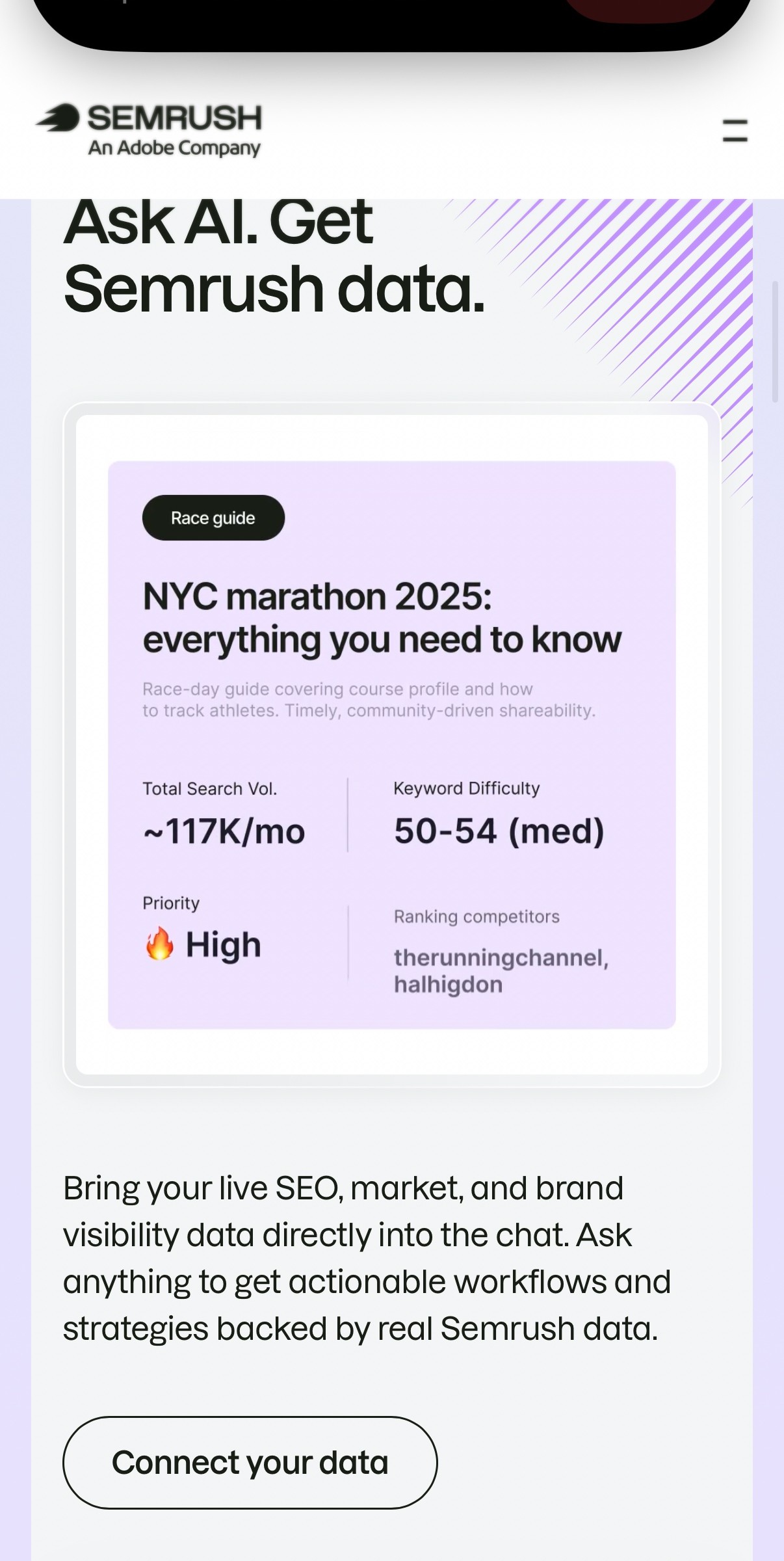
SEMrush. This is the one we use. Its AI Visibility Toolkit monitors whether your pages are actually getting cited across ChatGPT, Google AI Overviews, Gemini, and Perplexity: an AI Visibility Score, which prompts trigger your brand, how you’re described, and how you compare to competitors. Its AI site audit flags what’s technically holding you back. Ideas from Answer the Public in, proof from SEMrush out.
Ahrefs. Its Brand Radar module tracks AI mentions tied to its backlink index — strong on research and seeing the competitive landscape. Lighter on content suggestions, though its AI Content Helper add-on gives optimization guidance.
Moz. AI visibility dashboards alongside its traditional authority metrics (Domain Authority, Brand Authority). A fit if your reporting already runs on Moz scores.
Profound. Tracks across the widest set of answer engines and pairs it with content agents that build AI-optimized content from what the tracking reveals.
Otterly.AI. A lower entry price point, with content audits and GEO recommendations.
Here’s what that looks like inside the platforms.
The point: the tool should give you direction, not just a scoreboard. Install them, watch the numbers, and let the pattern tell you what to make more of. Without them, you’re doing the work blind.
Why is this happening?
This isn’t a trend to wait out. About 60% of searches in the US and EU now produce zero clicks, because the AI answer sits above the results — and when an AI Overview appears, clicks to the top organic result drop by nearly half (Pew Research, March 2025).
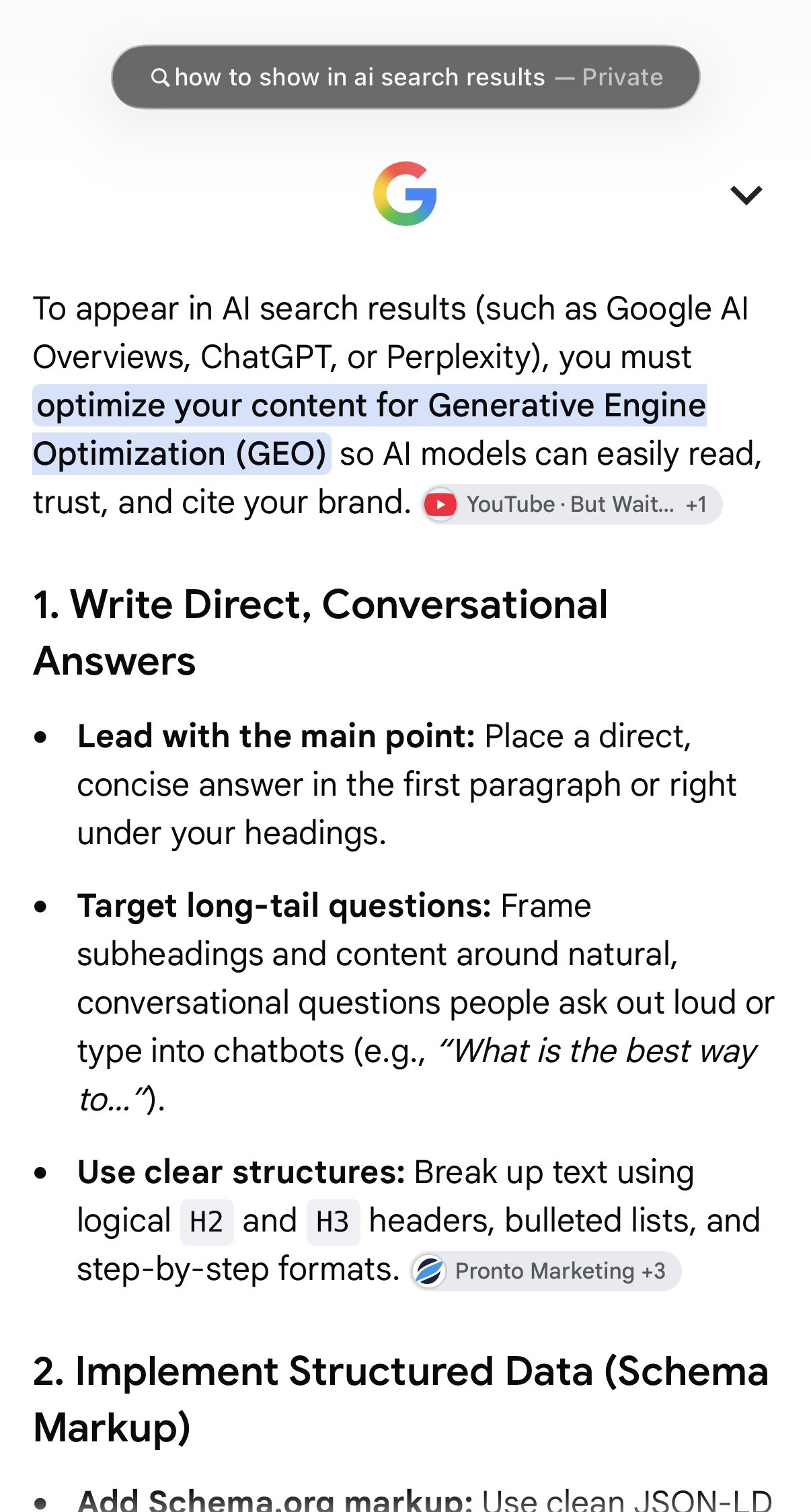
Here’s a live example — this is what Google’s AI currently tells people who search for how to show up in AI search results:
Here’s the part that surprises most people: ranking well in Google doesn’t guarantee you’ll be the cited answer. A Surfer SEO analysis of over 173,000 URLs found that 68% of pages cited in AI Overviews were not in the top ten organic results. An Ahrefs study found only 12% of ChatGPT citations came from Google’s top ten.
Read that again. Two-thirds of the pages AI cites aren’t the pages Google ranks. The old playbook and the new one have split apart.
The good news: this is an opening, not a threat. Citation data shows that mid-size, authoritative sites earn the majority of AI citations — you don’t need to outrank the biggest publications on the internet. You need to be the clearest, most trustworthy voice on the specific questions your customers ask.
What gets you cited in AI answers?
This is the practical part — what we’ve seen move the needle:
Press mentions. This one is huge. When reputable publications mention your brand, it builds the kind of credibility AI systems trust — and credibility turns into citations.
Review platforms. Being reviewed, and reviewed well, on the platforms in your industry tells answer engines that real customers vouch for you.
Wikipedia citations. Getting cited in Wikipedia has been a big driving factor for AI search results. It’s one of the most trusted sources these systems draw from.
Guides. In-depth, genuinely useful guides on your topic. The kind of content an AI can pull a complete answer from.
Social media — posted frequently. This one surprises people. AI systems cite social posts, including Instagram, far more than most brands expect. But it rewards volume and consistency. Posting extremely frequently beats posting occasionally.
That last point deserves emphasis, because a lot of results showing up in Google search right now are actually coming from Instagram. Creating that content doesn’t just feed the algorithm on the platform — it feeds Google’s results too. If you’re posting consistently, you have two discovery surfaces working for you instead of one.
Underneath all of that is structure. Write your headings as the actual questions people ask. Answer in the first 40 to 60 words, then expand. Use numbered lists for processes, bullet lists for sets, tables for comparisons. Add schema markup so machines can read what the page contains. Show your expertise with author bylines, dates, sources, and original data.
What could be blocking you?
Before you build anything, check what might be blocking the AI from your site in the first place. One of the most common problems we see: a website that’s accidentally telling AI crawlers to stay out — usually through the robots.txt file or a crawler-blocking setting the site owner never knew was on. If GPTBot, Claude’s crawler, or Perplexity’s bot can’t read your pages, you can’t be cited, no matter how good the content is.
Ask your SEO specialist directly: are AI crawlers allowed on our site, and what tools are you using to check? If they can’t answer, that’s an answer.
The don’ts of AEO
A quick list of what not to do — because we’re seeing all of these in the wild:
Don’t publish unedited AI content. There are platforms now that suggest what to write and then have AI write it for you. Use them for the draft if you want — but a human has to go in and add their own tweaks, their own quotes, their own case studies and examples. Generic, untouched AI output — “AI slop” — is the fastest way to sound like everyone else and get cited by no one.
Don’t block the crawlers. Check robots.txt before you do anything else.
Don’t rely on tricks like llms.txt files to rank. They don’t work as ranking factors.
Don’t mark up content with schema that isn’t visible on the page. That’s a fast way to lose trust.
Don’t bet everything on one channel. If your whole strategy is one platform, one tactic, one type of post — you’re building on a single point of failure.
Don’t treat tracking as the whole job. The tools tell you where you’re invisible. Fixing it takes content and earned mentions — the work described above.
What most people get wrong about AEO
A few things worth clearing up, because the misconceptions are costing businesses visibility:
AEO doesn’t replace SEO. SEO is the foundation — without a crawlable, fast, authoritative site, AEO doesn’t work. They run together.
You don’t need to be a giant brand. The data says smaller, authoritative sites win citations all the time.
Being cited without a click isn’t a loss. When the AI names you, that’s brand authority inside the conversation — and it sticks.
It’s not a one-time project. AI systems reward current, factual, trustworthy sources. Fresh content gets cited more.
How we run this for clients
Here’s our process, so you can see what the work actually looks like:
We make sure nothing is blocking AI crawlers on your site.
We do PR — because press mentions are one of the strongest citation signals there is.
We get clients cited in Wikipedia — one of the most trusted sources AI systems draw from.
We use Answer the Public to find the questions people are actually searching, and we write blogs and create social media posts that answer them.
We keep the website updated — fresh content gets cited more.
We pick content types using Answer the Public and Google Search Trends, so the content natively shows up where the audience already is.
We install the monitoring — GA4 with an AI channel, Search Console, Bing Webmaster Tools, SEMrush — so we can see what’s working and do more of it.
That’s the discipline, end to end. Answer real questions, in the places real people ask them, and measure whether it’s landing.
Is AI killing website traffic?
There’s a common belief that AI just answers in the chat and nobody clicks through anymore. That’s not what we’re seeing. Our clients are seeing increases in website traffic because they’re showing up in AI search results — and the engines tell you where the traffic came from.
So monitor it. Watch the trend: how much traffic is AI driving, which pages is it sending, and where did it come from — AI, social, organic? Treat the numbers as a minimum, since some AI visits show up as direct. Let the pattern tell you what to make more of.