How to Spot Fake Influencers
You’re about to pay someone with 200k followers to post about your brand, the follower count looks impressive, the media kit looks impressive, everything seems safe. then the post goes live, the likes roll in — and nothing happens. No traffic. No sales. Nothing.
You’ve just paid for an audience that doesn’t exist.
This happens constantly. Research puts fake followers at over a third of influencer audiences — and the accounts brands buy most, in the 100K to 500K range, are the worst for it.
Clients come to us after this has happened to them. Or they’re hesitant when influencer marketing comes up in their strategy — because they’ve been burned before.
You’re not alone: an estimated $4.6 billion is wasted on influencer fraud every year. It happens to the best of brands.
Here’s how we make sure it doesn’t happen again.
We’ve been on both sides since 2014
We’ve been managing influencers for our clients since 2014 — before most people even knew what an influencer was. We’ve done EGC content and trade deals, and we understand both sides of it: hiring influencers for brands, and managing the personal brands that are influencers themselves.
That means we know what influencers are looking for in a deal, what type of content actually converts, and how to spot a fake from either side of the table.
If you’re an influencer, read this
Not every fake influencer is a scammer. A lot of them fell victim to buying likes because they didn’t know better — they were told the likes were real.
We had a client come to us who swore the likes they’d bought were real people. We had to tell them they weren’t, and we had to clean it up for them — because it hurts the algorithm. A lot of influencers do it once, thinking it’s an investment. But long-term, it damages the account. They started with good numbers, fell victim to it, and never had a cleanup crew come back in and remove all those inactive followers.
So it’s not always intentional. But it still means they’re not a good fit for a brand deal — and if it’s your account, it’s worth fixing before it costs you real partnerships.
Here’s the truth brands are starting to understand: it’s better to work with a micro-influencer whose audience is authentically engaging, commenting, and purchasing than a 2-million-follower account whose audience just isn’t engaged. Smaller and real beats bigger and hollow, every time.
The red flags we check first
Forget the follower count. Here’s what actually tells you the truth:
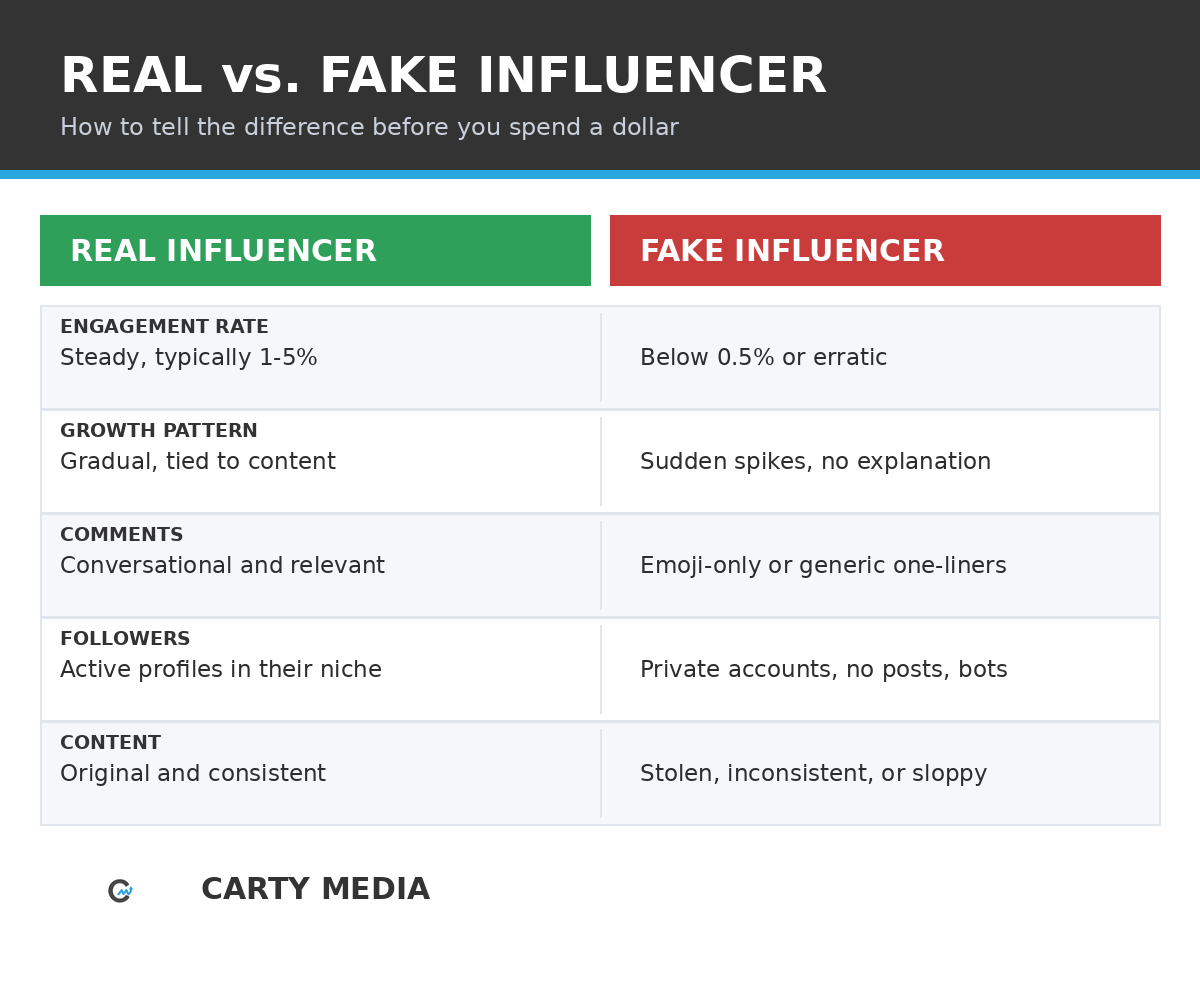
High followers, low engagement. The classic mismatch. Hundreds of thousands of followers and a few hundred likes per post? That audience isn’t real — or isn’t paying attention, which amounts to the same thing.
Click into the followers. This is the check most people skip. Scroll through who’s actually following them. A lot of private accounts with no posts. Accounts with little to no posts at all. If the follower list looks like a graveyard of empty profiles, you’re looking at purchased followers.
High engagement, no real comments. This one’s sneakier. The like count looks healthy — but read the comments. No authentic conversation. No long comments. Just short emojis, or comments that are all a couple of words with similar themes. Real audiences talk. Bot audiences decorate.
The screenshot trick
Here’s something most brands don’t know: it’s easy for an influencer to post a screenshot of one campaign they threw money at — or one where they went and bought the likes and comments. Yes, you can buy those.
But they aren’t doing it on every post.
That’s why you can’t judge an influencer by their best post or their media kit. Look at the pattern across all their posts. One post with 10,000 likes surrounded by posts with 400 likes isn’t a viral hit — it’s a purchased one. Using a tool that spots this pattern for you is key, because the human eye misses what the data catches.
Real vs. fake: the comparison
Tools that check for you
Manual checks catch a lot. But the right platform catches what you can’t see — audience quality scores, fraud patterns across every post, bot networks. These are the tools worth knowing:
- HypeAuditor. Audience quality scoring, follower authenticity breakdowns, engagement authenticity metrics. The standard for deep vetting.
- Modash. Fake follower detection with a fraud score built on growth velocity — built to catch the sudden spikes that signal purchased followers.
- Social Blade. Free growth-trend tracking. The fastest way to see whether an account grew organically or in suspicious jumps.
- Heepsy. Follower location and audience analysis — useful when the audience geography doesn’t match the influencer’s market.
How we vet influencers for clients
Our process is simple: the tool runs first, our eyes run second. The platform flags the audience quality, the fraud patterns, the engagement consistency across every post — the things no screenshot can fake. Then we do the manual checks above: the follower list, the comment quality, the pattern across posts.
An influencer who’s real passes both. An influencer who’s faking it almost never does.
Talk to us
If influencer marketing is on your plan this year, don’t buy the follower count — buy the proof. Book a fit call and we’ll show you how we vet: https://cartymedia.17hats.com/p#/scheduling/rJ_cCRZMyOck/s/114147