How to Show Up in AI Search Results
You’ve likely heard of AEO by now — or you’ve noticed something changing and you don’t have a name for it yet.
Your customers are using ChatGPT to get answers. They’re seeing Google’s AI Overview at the top of their searches instead of clicking through to websites. And if you’re watching your traffic, you’ve probably felt it: the rules you learned for SEO aren’t delivering the way they used to. You’re not sure how to show up in the results anymore — because the results themselves have changed.
That’s what AEO is about. Answer engine optimization is how your brand becomes the source an AI cites when it answers a question. Not ranking in a list of ten blue links — being named in the answer itself.
If you know SEO, you already understand half of it. SEO gets your website to rank in Google’s results. AEO gets your brand cited when an AI gives the answer instead. Same goal — visibility — on a different surface.
Everything in this article is measured with real tools — the same platforms we use for clients, starting with SEMrush. You’ll see them, with screenshots, below.
Tools for AI Search Results
Here’s the part most articles skip, and it’s the most important one. Without the right tools installed, you have no idea whether any of this work is actually working. You need to see it — which pages are being cited, how much traffic AI is sending, and where that traffic goes next.
Start with the free tools, which you should already have:
- Google Analytics 4. Go to Acquisition, then Traffic Acquisition, and add session source as a dimension. You’ll see referrals from chatgpt.com, perplexity.ai, and the other AI engines. Set up a dedicated AI channel so that traffic is tracked separately from regular referrals — then you can see AI visits, which pages they land on, and whether they convert.
- Google Search Console. Watch which queries are triggering AI summaries and how your pages perform on them.
- Bing Webmaster Tools. ChatGPT pulls current web content through Bing’s index, so your Bing visibility directly affects whether ChatGPT can find you.
Those tell you what happened. The platforms below tell you what to make next — and whether it worked.
Platforms That Give You Ideas and Track Your Progress
This is the layer most businesses skip: the platforms that tell you what to create, and then monitor whether it’s working.
For the ideas, we use Answer the Public. It shows the actual questions people are searching — and we turn those into blogs and social media posts that answer them. That’s where the content ideas come from: real questions, not guesses.
For the tracking, we use SEMrush:
- SEMrush. This is the one we use. Its AI Visibility Toolkit monitors whether your pages are actually getting cited across ChatGPT, Google AI Overviews, Gemini, and Perplexity: an AI Visibility Score, which prompts trigger your brand, how you’re described, and how you compare to competitors. Its AI site audit flags what’s technically holding you back. Ideas from Answer the Public in, proof from SEMrush out.
- Ahrefs. Its Brand Radar module tracks AI mentions tied to its backlink index — strong on research and seeing the competitive landscape. Lighter on content suggestions, though its AI Content Helper add-on gives optimization guidance.
- Moz. AI visibility dashboards alongside its traditional authority metrics (Domain Authority, Brand Authority). A fit if your reporting already runs on Moz scores.
- Profound. Tracks across the widest set of answer engines and pairs it with content agents that build AI-optimized content from what the tracking reveals.
- Otterly.AI. A lower entry price point, with content audits and GEO recommendations.
Here’s what that looks like inside the platforms.
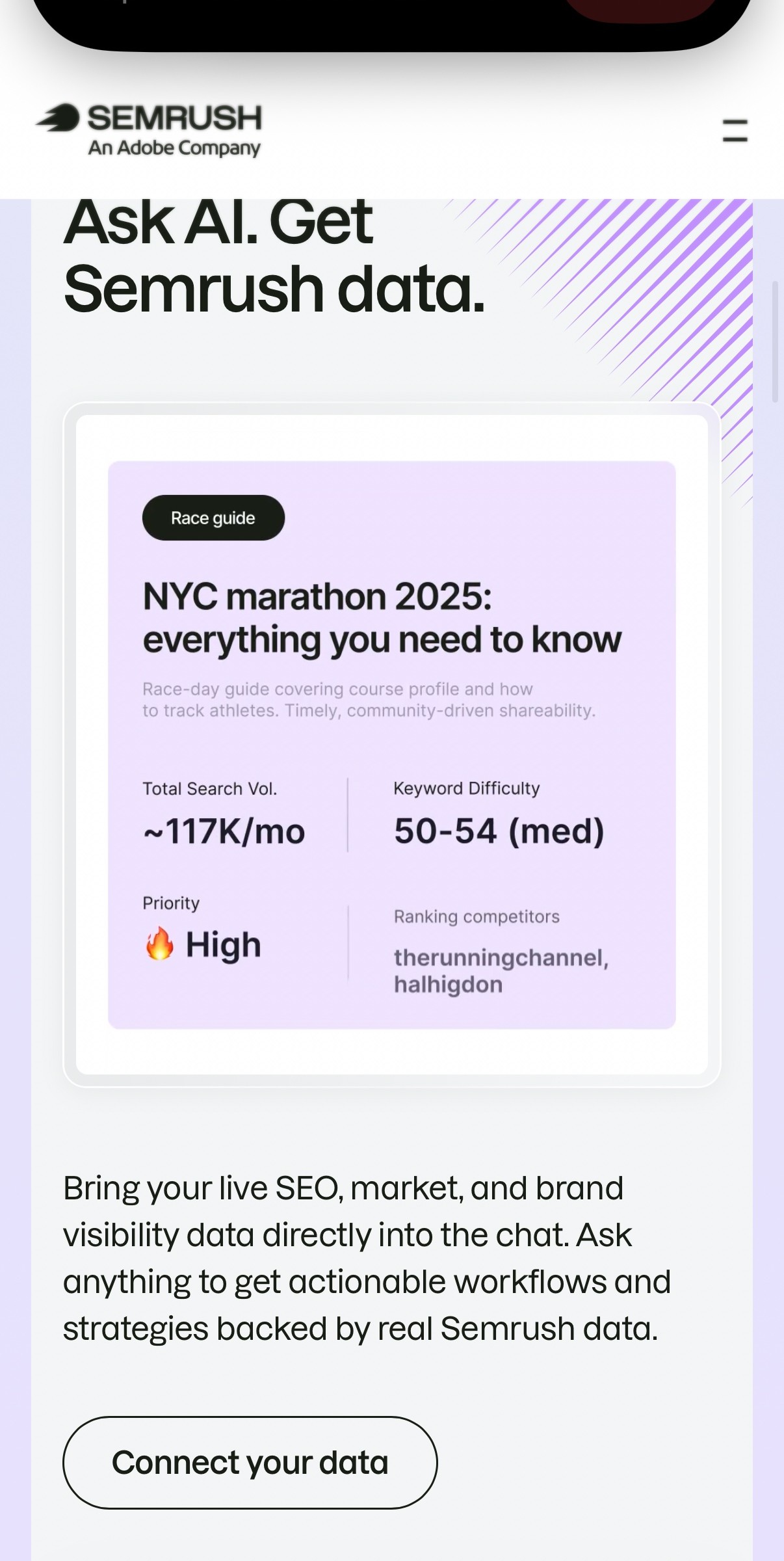
The point: the tool should give you direction, not just a scoreboard. Install them, watch the numbers, and let the pattern tell you what to make more of. Without them, you’re doing the work blind.
Why is this happening?
This isn’t a trend to wait out. About 60% of searches in the US and EU now produce zero clicks, because the AI answer sits above the results — and when an AI Overview appears, clicks to the top organic result drop by nearly half (Pew Research, March 2025).
Here’s a live example — this is what Google’s AI currently tells people who search for how to show up in AI search results:
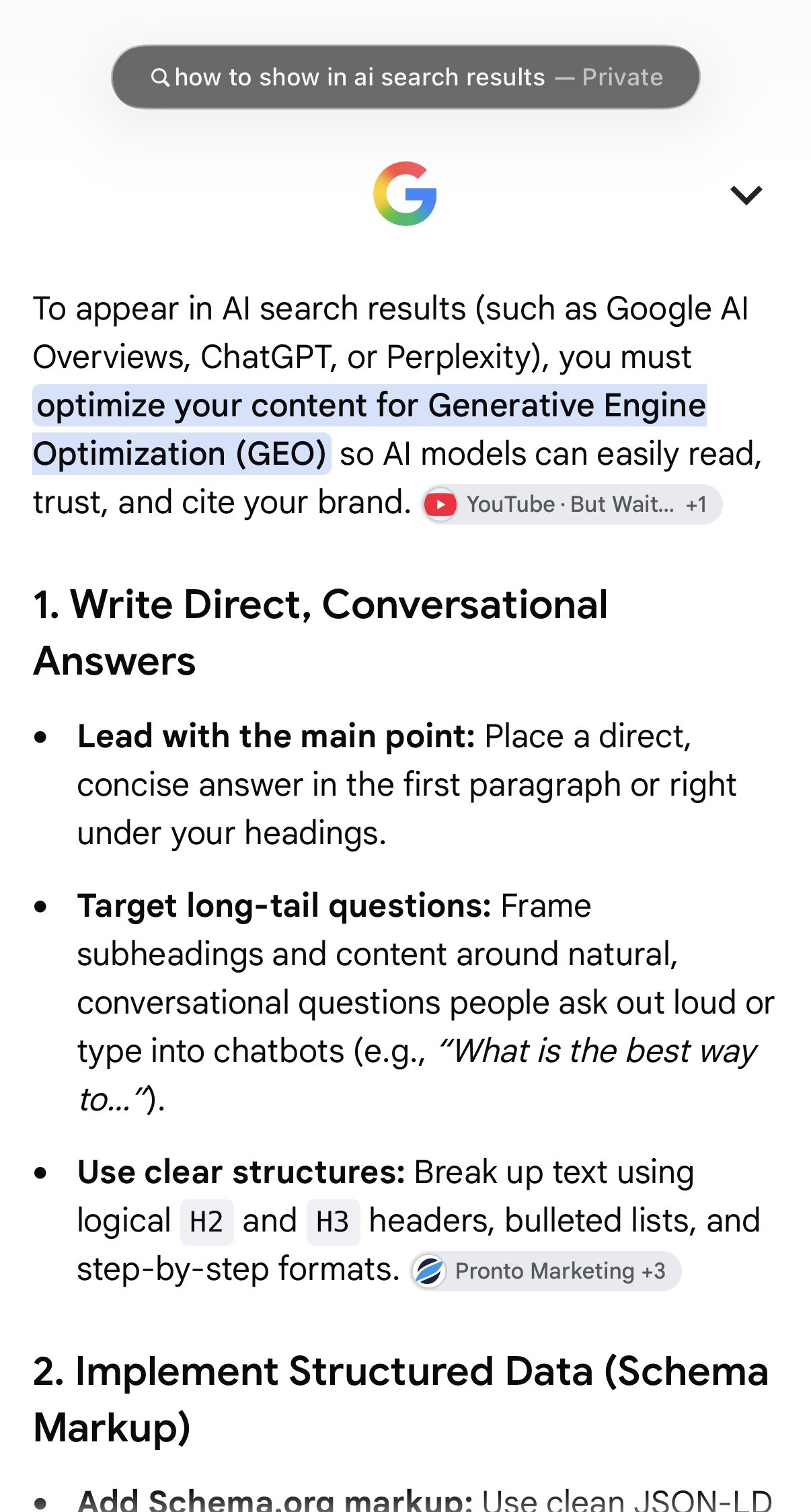
Here’s the part that surprises most people: ranking well in Google doesn’t guarantee you’ll be the cited answer. A Surfer SEO analysis of over 173,000 URLs found that 68% of pages cited in AI Overviews were not in the top ten organic results. An Ahrefs study found only 12% of ChatGPT citations came from Google’s top ten.
Read that again. Two-thirds of the pages AI cites aren’t the pages Google ranks. The old playbook and the new one have split apart.
The good news: this is an opening, not a threat. Citation data shows that mid-size, authoritative sites earn the majority of AI citations — you don’t need to outrank the biggest publications on the internet. You need to be the clearest, most trustworthy voice on the specific questions your customers ask.
What gets you cited in AI answers?
This is the practical part — what we’ve seen move the needle:
- Press mentions. This one is huge. When reputable publications mention your brand, it builds the kind of credibility AI systems trust — and credibility turns into citations.
- Review platforms. Being reviewed, and reviewed well, on the platforms in your industry tells answer engines that real customers vouch for you.
- Wikipedia citations. Getting cited in Wikipedia has been a big driving factor for AI search results. It’s one of the most trusted sources these systems draw from.
- Guides. In-depth, genuinely useful guides on your topic. The kind of content an AI can pull a complete answer from.
- Social media — posted frequently. This one surprises people. AI systems cite social posts, including Instagram, far more than most brands expect. But it rewards volume and consistency. Posting extremely frequently beats posting occasionally.
That last point deserves emphasis, because a lot of results showing up in Google search right now are actually coming from Instagram. Creating that content doesn’t just feed the algorithm on the platform — it feeds Google’s results too. If you’re posting consistently, you have two discovery surfaces working for you instead of one.
Underneath all of that is structure. Write your headings as the actual questions people ask. Answer in the first 40 to 60 words, then expand. Use numbered lists for processes, bullet lists for sets, tables for comparisons. Add schema markup so machines can read what the page contains. Show your expertise with author bylines, dates, sources, and original data.
What could be blocking you?
Before you build anything, check what might be blocking the AI from your site in the first place. One of the most common problems we see: a website that’s accidentally telling AI crawlers to stay out — usually through the robots.txt file or a crawler-blocking setting the site owner never knew was on. If GPTBot, Claude’s crawler, or Perplexity’s bot can’t read your pages, you can’t be cited, no matter how good the content is.
Ask your SEO specialist directly: are AI crawlers allowed on our site, and what tools are you using to check? If they can’t answer, that’s an answer.
The don’ts of AEO
A quick list of what not to do — because we’re seeing all of these in the wild:
- Don’t publish unedited AI content. There are platforms now that suggest what to write and then have AI write it for you. Use them for the draft if you want — but a human has to go in and add their own tweaks, their own quotes, their own case studies and examples. Generic, untouched AI output — “AI slop” — is the fastest way to sound like everyone else and get cited by no one.
- Don’t block the crawlers. Check robots.txt before you do anything else.
- Don’t rely on tricks like llms.txt files to rank. They don’t work as ranking factors.
- Don’t mark up content with schema that isn’t visible on the page. That’s a fast way to lose trust.
- Don’t bet everything on one channel. If your whole strategy is one platform, one tactic, one type of post — you’re building on a single point of failure.
- Don’t treat tracking as the whole job. The tools tell you where you’re invisible. Fixing it takes content and earned mentions — the work described above.
What most people get wrong about AEO
A few things worth clearing up, because the misconceptions are costing businesses visibility:
- AEO doesn’t replace SEO. SEO is the foundation — without a crawlable, fast, authoritative site, AEO doesn’t work. They run together.
- You don’t need to be a giant brand. The data says smaller, authoritative sites win citations all the time.
- Being cited without a click isn’t a loss. When the AI names you, that’s brand authority inside the conversation — and it sticks.
- It’s not a one-time project. AI systems reward current, factual, trustworthy sources. Fresh content gets cited more.
How we run this for clients
Here’s our process, so you can see what the work actually looks like:
- We make sure nothing is blocking AI crawlers on your site.
- We do PR — because press mentions are one of the strongest citation signals there is.
- We get clients cited in Wikipedia — one of the most trusted sources AI systems draw from.
- We use Answer the Public to find the questions people are actually searching, and we write blogs and create social media posts that answer them.
- We keep the website updated — fresh content gets cited more.
- We pick content types using Answer the Public and Google Search Trends, so the content natively shows up where the audience already is.
- We install the monitoring — GA4 with an AI channel, Search Console, Bing Webmaster Tools, SEMrush — so we can see what’s working and do more of it.
That’s the discipline, end to end. Answer real questions, in the places real people ask them, and measure whether it’s landing.
Is AI killing website traffic?
There’s a common belief that AI just answers in the chat and nobody clicks through anymore. That’s not what we’re seeing. Our clients are seeing increases in website traffic because they’re showing up in AI search results — and the engines tell you where the traffic came from.
So monitor it. Watch the trend: how much traffic is AI driving, which pages is it sending, and where did it come from — AI, social, organic? Treat the numbers as a minimum, since some AI visits show up as direct. Let the pattern tell you what to make more of.
Talk to us
If your customers are asking AI instead of Googling, the question is whether your brand is in the answer. Book a fit call and we’ll tell you honestly where you stand: https://cartymedia.17hats.com/p#/scheduling/rJ_cCRZMyOck/s/114147