What Is a Fractional CMO?
If you searched “what is a fractional CMO” and landed here, you’re likely familiar with what a chief marketing officer is — but want to learn more about what fractional means, and how it could potentially be what you need for your business.
Here’s the direct answer: a fractional CMO is an experienced marketing executive who does the chief marketing officer job for your company part-time, on retainer, instead of as a full-time employee. “Fractional” simply means you get a fraction of their time — and pay a fraction of the cost — while they typically work with a small number of companies at once.
That means the same seat at the table you’d get from a full-time hire: ownership of marketing strategy, the budget, the team, and the results. The difference is the structure. Instead of a salary, benefits, equity, and a months-long executive search, you get senior leadership calibrated to what your business actually needs right now — for as long as you need it.
Businesses usually land here for one of two reasons. Either they’ve outgrown doing marketing without senior leadership but can’t justify a full-time executive hire, or they’ve already tried the full-time route and watched the seat turn over. Both are more common than most founders admit.
What does a CMO actually do?
CMO stands for chief marketing officer — but if you’re here, you probably already know that.
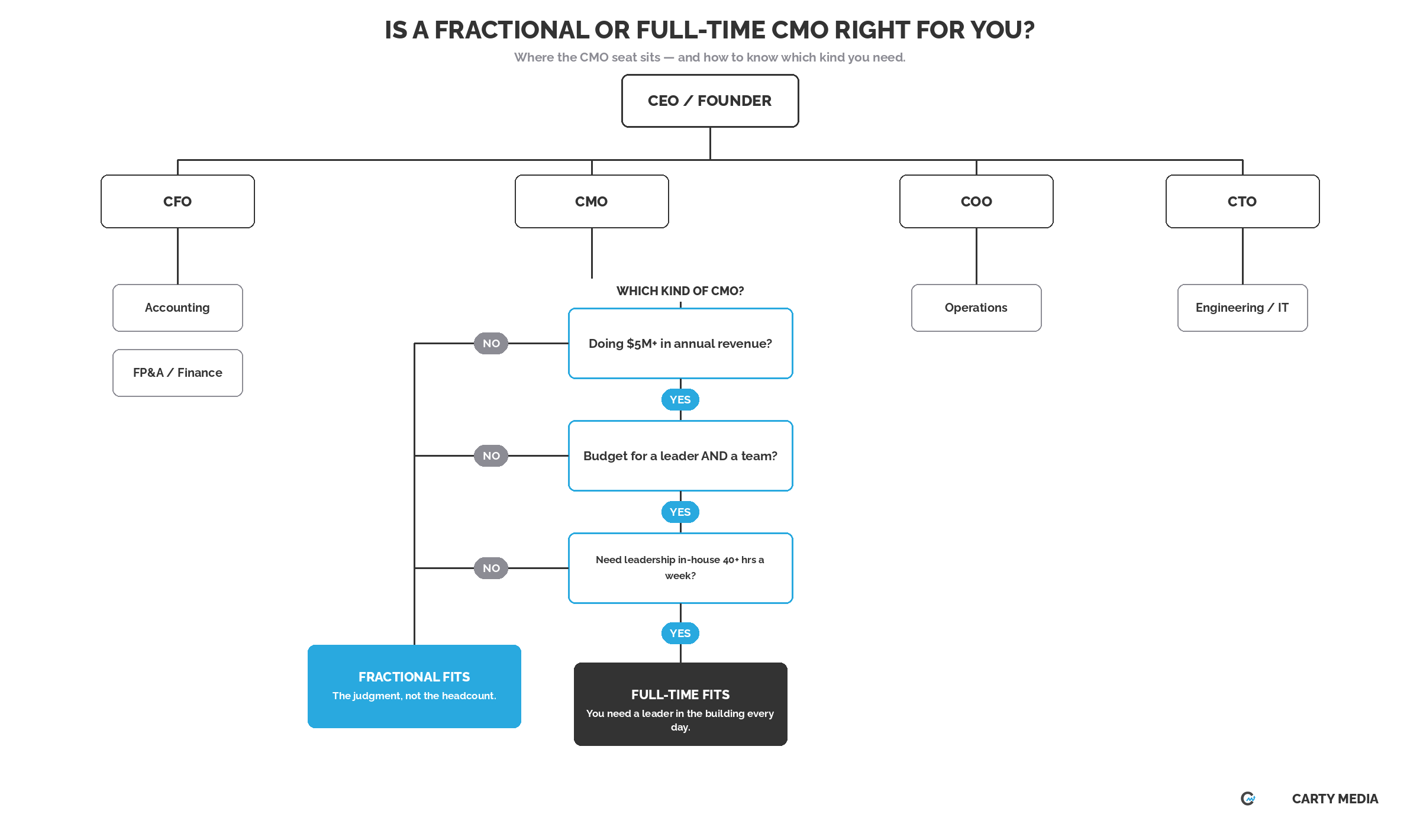
A chief marketing officer sits on the executive team. The seat is typically reserved for businesses doing at least $5M in annual revenue, or with a marketing team of 3 or more (smallbusiness.management). It’s not an entry point into marketing leadership — it’s the top of it, and the expectations reflect that.
What makes the role different from every other marketing title is scope and accountability. A marketing manager runs campaigns. A director runs a department. A CMO owns the entire function: what the business is trying to achieve through marketing, the plan to get there, the money behind it, the people executing it, and the results at the end. When marketing works, the CMO gets the credit. When it doesn’t, there’s no one else to point to.
What a CMO actually does all day
Here’s what the title means in practice: a CMO doesn’t run campaigns. They run the people who run campaigns. They set the strategy, hand it to their team, check in on progress, manage the projects through to completion, control the budget, and answer for the results. Delegation, oversight, accountability — that’s the day-to-day.
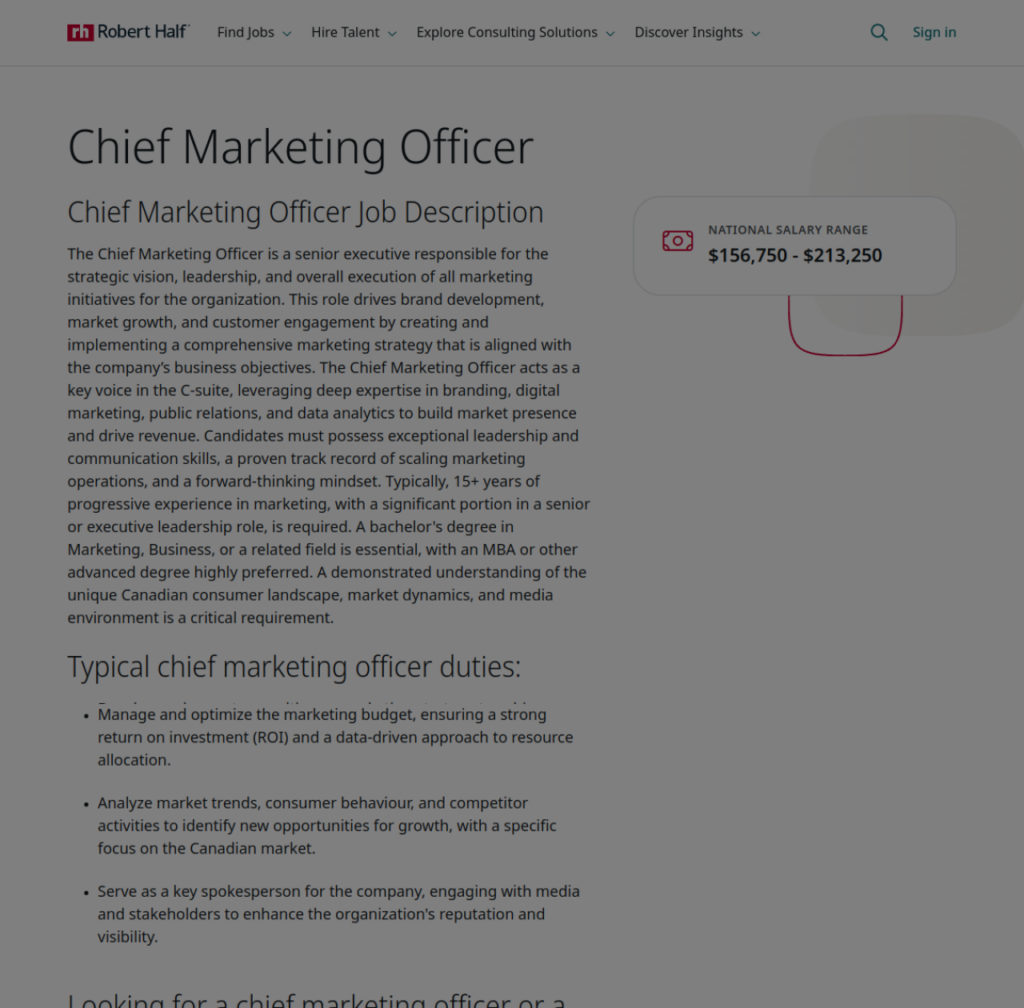
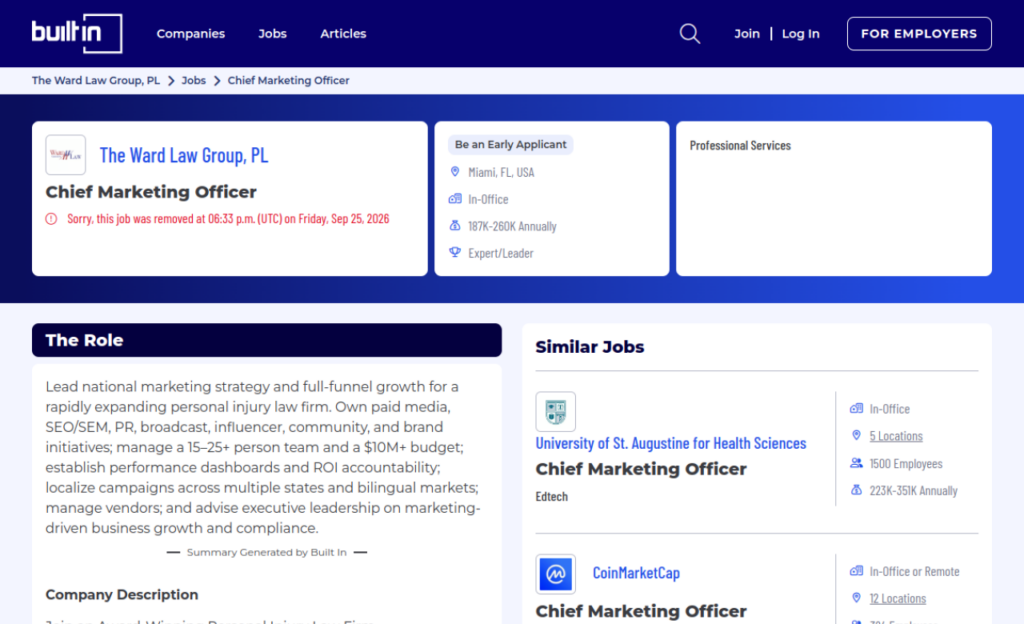
Don’t take my word for it. Here’s what real CMO job listings actually ask for:
- Set the multi-year marketing strategy and the annual plan behind it (Robert Half’s CMO spec: “develop and execute a multi-year marketing strategy to achieve business growth, brand recognition, and market share objectives”)
- Hire, lead, mentor, and manage the entire marketing department — recruiting, training, goal-setting, evaluations (Chicago Public Media’s CMO posting; The Ward Law Group: “manage a 15–25+ person team”)
- Own the marketing budget and optimize it for ROI (The Ward Law Group: “$10M+ budget”; Robert Half: “manage and optimize the marketing budget, ensuring a strong return on investment”)
- Oversee every marketing function: brand, PR, digital, demand generation, product marketing, research (Robert Half)
- Manage projects from the initial brief through execution to final evaluation (Creative Direct Marketing Group: “manage projects from initial creative brief, execution, and strategic evaluation upon completion”)
- Serve as a trusted advisor to the CEO and sit on the executive leadership team (Chicago Public Media; The Ward Law Group: “advise executive leadership on marketing-driven business growth”)
- Align marketing with sales, product, and company objectives; manage vendors, agencies, and partners
- Define the KPIs, build the reporting dashboards, and answer for the numbers (The Ward Law Group: “establish performance dashboards and ROI accountability”)
Read that list carefully, because it’s the standard any fractional CMO has to meet too. A fractional title doesn’t mean a fractional skill set — it means a full skill set applied fractionally. If someone calling themselves a fractional CMO couldn’t do every item on that list, they’re not a CMO. They’re a consultant with a better title.
What does a full-time CMO cost?
A full-time CMO in California averages around $173,000 in base salary, with ranges running from under $100,000 to over $310,000 — and as a C-suite executive, the package typically includes bonuses and equity on top of that. National total compensation runs even higher.
And the salary is only part of the commitment. There’s the executive search to find them, the benefits package, the payroll taxes, the equity grants, and — statistically — the likelihood that the seat turns over in about four years, starting the whole expensive cycle over again.
So the question isn’t whether the role matters. It’s whether you need all of it, full-time, right now.
Should you hire full-time or fractional?
The short version: a fractional CMO does the CMO job — strategy, budget, team, results — part-time, on retainer, for a fraction of the full-time cost. No benefits burden, no payroll overhead, no months-long executive search, no severance risk when it’s time for a change.
Fractional CMO vs. consultant vs. agency
People mix these up constantly, so let’s separate them clearly — because hiring the wrong one is an expensive mistake.
A consultant advises. They come in, analyze, hand you a plan, and leave. What happens after that is your problem. Consultants are useful when you have a specific question and the team to execute the answer. They’re the wrong hire when nobody senior will own what happens next.
An agency executes. They run the ads, post the content, build the campaigns — the tactics you point them at. Good agencies are excellent at their disciplines. But someone has to point them, coordinate them, and hold them accountable to revenue — and that someone is usually the founder or CEO, who has a company to run.
A fractional CMO leads. They sit on your leadership team, own the marketing function, hold the team (or the agency) accountable week over week, and answer for results — not just recommendations. Strategy plus execution oversight, with a name attached to the outcome.
If you only need a plan, hire a consultant. If you only need hands, hire an agency. If you need someone to own the whole thing without hiring a full-time executive, that’s the fractional seat.
| Consultant | Agency | Fractional CMO | |
|---|---|---|---|
| What they do | Advise: analyze, hand you a plan, leave | Execute: run the ads, post the content, build the campaigns | Lead: own the marketing function and answer for results |
| Best when | You have a specific question and a team to execute the answer | You need hands for defined tactics | You need ownership without a full-time executive hire |
| Watch out for | Nobody owns what happens after the plan | Nobody points them, coordinates them, or holds them to revenue | Needs real decision authority — without it, just commentary |
How to find one
The best fractional CMOs rarely advertise the way agencies do. They come through referrals — ask other founders or CEOs who runs their marketing leadership. Fractional executive networks and platforms exist specifically for this, and LinkedIn is full of people using the title, which is exactly why the vetting matters more than the sourcing.
When you’re looking, ignore the follower counts and the course certificates. Look for someone who has actually held the CMO title at a real company — not just called themselves one online. Look at how long their clients stay; retention is the metric that matters. And be wary of anyone whose entire track record is teaching other people to become fractional CMOs. The title got popular faster than the track records behind it, and the people selling the dream are rarely the ones living it.
A real fractional CMO will want to audit your marketing before quoting you anything. Anyone who gives you a price before understanding your business is selling a package, not leadership.
Is a fractional CMO right for you?
The timing usually looks like one of these:
You’re spending on marketing — ads, content, freelancers — but nobody senior owns the overall plan or can draw a line from the spend to revenue. That’s the most common one. Money goes out, activity happens, and nobody can say what it’s producing.
You have people who can execute, but they’re operating without direction. The social person posts, the ads person runs ads, the freelancer writes blogs — each doing their own thing, none of it adding up to a strategy.
Your marketing team is underperforming and you can’t tell whether it’s the people, the strategy, or both. An outside senior leader can diagnose that in weeks; an internal team usually can’t diagnose itself at all.
You’re between CMOs and need continuity instead of a six-month gap. This is one of the cleanest uses of the model — leadership now, no rushed permanent hire.
You’re launching something new — a product, a market, a brand — and need senior judgment from day one rather than learning expensive lessons in public.
You’re growing fast and the founder-led marketing that got you here won’t get you there. What works at one stage breaks at the next, and recognizing that early saves real money.
The common thread: the business has outgrown do-it-yourself marketing, but a full-time executive hire is premature — or already happened and didn’t work out.
And the honest inverse: it’s the wrong move if you don’t have clear growth objectives yet, if you’re expecting overnight fixes, if leadership will resist every change proposed — or if you’re not ready to trust the expert and want your hands on everything anyway. A fractional CMO who can’t get decisions made, or whose decisions get rewritten in the meeting, is just an expensive spectator. Fix the foundation first, then hire the leader.
Who do you hire first — the CMO or the team?
This is the question almost nobody asks out loud, and it’s one of the most expensive ones to get wrong.
The most common mistake looks like this: the CEO hires a few marketers — a social person, a content person, maybe an agency — and tries to direct them all personally. It feels efficient. It’s not. The CEO has a company to run, and marketers without senior leadership produce disconnected activity: posts that don’t tie to pipeline, ads with no strategy behind them, everyone busy and nothing compounding. That’s not a team. That’s a collection of freelancers with the same boss.
The opposite mistake is hiring a full-time CMO too early. An executive-level marketer with no team to lead and no budget to deploy will struggle — not from lack of skill, but from lack of leverage. You’re paying for leadership with nothing to lead. Many founders learn this one the expensive way.
The answer the industry keeps landing on: hire the leader first, then build the team around them. The leader defines which roles you actually need, what those people should be accountable for, and in what order to hire them. Without that, you’re guessing at job descriptions.
And “leader first” doesn’t have to mean a full-time CMO. The practical sequence most growing businesses follow looks like this:
The typical hiring sequence: around $2M in revenue, a fractional CMO setting strategy plus one strong doer (a marketing manager or a focused agency) to execute it. Around $10M, a marketing director running the day-to-day with fractional CMO leadership above them. Around $25M, a full-time VP of marketing — with CMO-level strategy still sitting above, fractional or as a planned hire. (geisheker.com)
Notice what that sequence is really saying: at almost every stage before $25M, the fractional model is the leadership answer. You get the person who decides what the team should be — before you spend a dollar building the wrong one.
Questions to ask before you hire one
When you’re talking to a candidate, these are the questions that separate operators from title-holders:
How many companies are you working with right now? You want someone with a small roster — stretched across a dozen clients, nobody gets leadership.
Who actually does the work? Some fractional CMOs are a one-person show; others bring a team. Neither is wrong, but you should know which you’re getting and who’s accountable for what.
What happens in the first 90 days? Listen for an audit, a strategy, and early wins — not a vague “discovery phase” with no deliverables.
How do you report, and how often? You want regular reporting against agreed goals, with the same senior person on your calls. If reporting is an afterthought in the pitch, it’ll be an afterthought in the engagement.
What does the engagement look like if it’s not working? The answer tells you everything about confidence. A real operator has a clean answer; a salesperson changes the subject.
Can I talk to a current client? Retention is the metric. If they can’t produce someone who’s been with them for years, ask yourself why.
(Our agency page has the longer version of this list — ten questions that go deeper. Start here, then take those with you.)
What are the pros and cons of a fractional CMO?
| Pros | Cons |
|---|---|
| Senior leadership without the full-time salary, benefits, equity, and overhead | Won’t fix a broken business model — wrong product, pricing, or market fit |
| Hours flex with what you need; a full-time hire can’t do that | Depends on execution capacity — with no team, agency, or budget, there’s nothing to lead |
| Outside perspective unclouded by internal politics | Limited hours by definition — communication has to be proactive on both sides |
| One person accountable for marketing outcomes instead of scattered vendors | Requires genuine buy-in — a fractional CMO with no authority is just commentary |
Weigh both lists honestly. The model is excellent for the right company at the right stage — and a waste of money for the wrong one.
How much does a fractional CMO charge?
Fractional CMOs generally work on a monthly retainer for an agreed block of hours — not a salary, not a project fee. The hours work the way an employee’s time works: if a month needs more strategy and less execution, the hours move. Nothing locked into a rigid package where you pay for services you didn’t use.
Some work on day rates. Some do project-based engagements for a defined outcome. But the retainer is the standard, because the value is continuity — the same senior person on your business month after month, not a series of one-off projects.
Here’s what the market actually looks like in 2026:
Market data: most fractional CMO engagements run 10–20 hours per week (about 15 typical). Monthly retainers range $5,000–$25,000, averaging $10,000–$12,000. Hourly advisory work runs $200–$500/hour; a method-based tracker of 52 job posts and 970 candidate profiles puts the average at $174/hour. Scope drives the number: strategy-only engagements run $5,000–$8,000/month, engagements where the CMO also manages the team, agencies, and budget run $7,000–$12,000, and full-stack engagements reach $15,000–$20,000. (Sources: RankedCMO 2026, AAJ / Go Fractional 2026, Optionality Lab 2026)
Important context: those figures buy leadership that directs a team or an agency — not someone doing the hands-on work themselves. The fractional CMO sets the strategy, runs the meetings, manages the budget, and holds executors accountable. The doing is done by the team or the agency underneath.
So what should you actually budget? Three lines: the fractional CMO retainer, the execution layer (salaries for a director and specialists, or agency retainers), and the ad/media spend itself. The mistake is budgeting for only one of the three — usually the CMO salary, with nothing left for the other two.
There’s a version of this math that plays out constantly: a company gets funding and immediately hires a full-time CMO — and that one salary eats so much of the marketing budget there’s nothing left for the actual team. No director. No social media manager. No execution budget. One expensive title and no one to do the work.
A fractional CMO flips that equation. When the company has a reasonable budget, the fractional model leaves room to spend it where it produces returns: a marketing agency — or several — executing the strategy, or an internal team built out properly. Leadership plus execution, instead of leadership instead of execution.
The trust problem (and why CEOs need the buffer)
One of the biggest problems in growing companies isn’t strategy or budget — it’s the CEO’s hands.
Most CEOs don’t have a marketing background. That’s not a criticism; they have a company to run. But without that background, two things happen constantly. First, it’s easy for them to get taken advantage of — by vendors, by agencies, by anyone selling marketing with confidence and no accountability. Second, it’s easy for them to get their hands into work their hands shouldn’t be on.
I’ve lost count of the times I’ve sat in a meeting as a fractional CMO while the CEO or founder gives feedback on an email campaign and ends up rewriting the whole thing — and now it’s no longer talking to the ideal customer at all. Any good marketer understands behavioral psychology. They know how to talk to the consumer. The CEO looks at the same email and asks why we’re talking about the benefits of the product line instead of the name of the product line. That’s the gap. It’s not about who’s smarter. It’s about who understands the customer.
This is also why the yes-man agency model fails. When a company goes straight from CEO to agency with no marketing leadership in between, the agency does whatever the CEO asks for — because that’s who signs the check. Nobody pushes back. Nobody says the email rewrite just killed the campaign. The company pays for activity and calls it marketing.
A fractional CMO is the buffer. And the whole thing only works if the CEO is ready to trust the expert. If they’re not — if they want their hands on everything — they don’t need a fractional CMO. They need to be honest about that first.
When a CEO does let go of the reins, that’s when the creative work happens. Think about the campaigns that built brands like Red Bull — the kind of ideas that would never survive a CEO’s first review. Those ideas come from a team at the drawing board, presented to a CMO who understands the customer well enough to say yes, budgeted with a CFO who trusts the expected return, and then delivered to the CEO as a win. That’s the chain. Remove the CMO from it and the chain breaks — the bold ideas die in the room, and the company gets safe marketing that nobody remembers.
What should you demand from a fractional CMO
This part matters, because not all fractional arrangements are equal. When you’re hiring a fractional CMO, make sure they’re not just blowing through months of retainer time building strategy and foundation work with nothing to show for it.
If they’re building the foundation, there should be solid deliverables attached to it. And from day one, they should be actively doing the job: communicating with your agency or your internal team, looking at the reporting, advising you — and your CFO or fractional CFO — on where the budget goes and why.
A fractional CMO who disappears into “strategy phase” for a quarter isn’t leading your marketing. They’re billing it.
Frequently asked questions
How much does a fractional CMO cost?
Most engagements run 10–20 hours per week on a monthly retainer of $5,000–$25,000, averaging $10,000–$12,000. Hourly advisory work runs $200–$500/hour. Scope drives the number — strategy-only is the lower end, running the team and budget is the higher end. (RankedCMO 2026)
How many hours a week does a fractional CMO work?
Typically 10–20 hours per week, about 15 on average. The hours flex with what the business needs — more strategy some months, more execution oversight in others.
What’s the difference between a fractional CMO and a marketing consultant?
A consultant advises — they analyze, hand you a plan, and leave. A fractional CMO leads — they sit on your leadership team, own the marketing function, and answer for results month after month.
At what stage should a company hire a fractional CMO?
The common pattern: around $2M in revenue, a fractional CMO setting strategy plus one strong doer to execute it. Around $10M, a marketing director runs the day-to-day with fractional leadership above. Around $25M, a full-time VP of marketing. (geisheker.com)
What should happen in a fractional CMO’s first 90 days?
An audit of your marketing, a strategy with early wins, and regular reporting against agreed goals. Not a vague “discovery phase” with no deliverables — and never a price quoted before they’ve understood your business.
Where this goes next
If you want the full picture — the deeper questions to ask, what the engagement actually looks like month to month, and how we do it — our fractional CMO agency page has all of it. And if you want an honest read on whether the model fits your stage, book a fit call: https://cartymedia.17hats.com/p#/scheduling/rJ_cCRZMyOck/s/114147