If you’re reading this, you’re here because you want to do the work. You know posting on social media matters for your business. But you’re getting a flood of conflicting advice about hashtags — use 30, use 5, use none, put them in the comments, hide them at the bottom — and it’s frustrating. Or maybe this is the first honest thing you’ve read on whether hashtags still work.
Here’s the direct answer: hashtags barely work anymore, and the ones that do work nothing like they used to. Instagram capped every post at 5 hashtags in December 2025 — enforced, not suggested — after telling creators for years that hashtags don’t drive reach. The algorithm now reads your captions, your voice, and your on-screen text to figure out what your post is about. It doesn’t need the little # symbol to understand you.
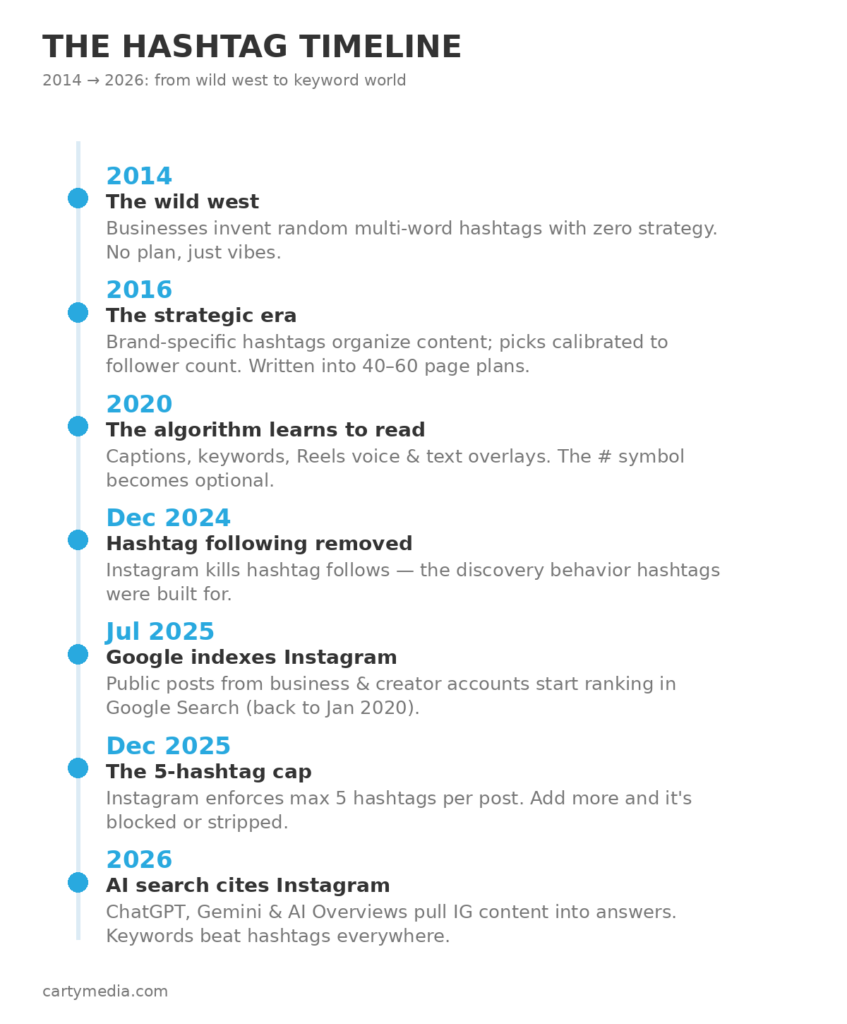
We’ve been in business since 2014 — back before most businesses knew what a hashtag was. We’ve watched the entire lifecycle: the wild west, the strategic era, and the slow fade into irrelevance. This is that story, and what to do instead.
We were there for the hashtag wild west
In the early days, hashtags were chaos. Businesses would invent hashtags on the spot — five or six random words smashed together — with no idea why they were doing it. There was no strategy. It was decoration that felt like marketing.
We got tired of watching clients sabotage themselves, so we started building hashtag strategy into every full-scope marketing plan we wrote — and those plans run 40 to 60 pages. If a client wanted to use a hashtag, we showed them the search results: here’s how many millions of posts already use it, here’s where you’d actually show up (spoiler: nowhere near the top), and here’s what to use instead.
Then hashtags got strategic — for a while
Once the dust settled, hashtags did have a real job, and we built genuine strategy around two ideas.
First, brand-specific hashtags. If a restaurant had a signature menu item, a specific location, a product, or a service, we’d create a hashtag nobody else had ever used. Customers could tap it and see only that content — just the photos of that one dish, not the entire restaurant feed. It worked like bookmarking: an aggregation tool that organized a brand’s content for its own audience. That was never about going viral. It was about organization and discoverability working together.
Second, follower-calibrated picks. This is the part most “hashtag gurus” never understood: you could only rank for a big hashtag keyword if you already had a big following. A national restaurant chain will show up for a tag like #burger. A local burger joint never would — not with 2,000 followers.
So we picked hashtags based on the client’s actual follower count, choosing tags they could realistically compete for instead of vanity tags that buried them on page 47 of the results.
This was real strategy. And then the platforms made it obsolete.
Why did the algorithm stop needing your hashtags?
Here’s the shift that killed the hashtag as a growth tool: the algorithm learned to read.
It started with captions. Instagram’s search stopped needing the # symbol — if the keyword was in your caption, that was enough. We changed our guidance immediately: only use a hashtag if the keyword wasn’t already in the caption. Anything more was stuffing. SEO had a name for this twenty years ago — keyword stuffing — and hashtags were doing the exact same thing. We did away with it entirely.
Then it went further. Location stopped needing a hashtag the moment you could pin it with the location tag. Product keywords just needed to be said naturally in the post.
And when Reels took over, the algorithm started reading what’s physically said out loud and what’s written in text overlays — pulling keywords straight from your voice and your screen, then surfacing the Reel in the For You feed, hashtag search, and keyword search without a single hashtag in the caption.
At every step, the machine needed the symbol less. The words were always the point.
What does Instagram actually say about hashtags?
This isn’t just our read of the situation. We sat in on a private Instagram session where they said it plainly: do not use hashtags anymore, and definitely don’t stuff them. Just use the keywords in your caption.
Instagram’s head, Adam Mosseri, has said the same thing publicly: hashtags help Instagram understand what a post is about, but they shouldn’t be treated as a way to get more distribution. They’re labels now, not megaphones. (source)
And here’s the part that should end the debate: the algorithm knows when you’re gaming it. If you tack a pile of unrelated keywords onto the end of a caption, Instagram can tell they have nothing to do with your post. If people don’t click, it ranks you lower. The stuffing doesn’t just fail — it backfires.
December 2025: the 5-hashtag cap made it official
In December 2025, Instagram capped hashtags at 5 per post — and it’s enforced. Add more and the platform blocks the post or strips the extras. A year earlier, in December 2024, they removed the ability to follow hashtags entirely, which killed hashtag browsing as a discovery path.
Read that again: you cannot follow hashtags anymore. The entire behavior hashtags were built for — browsing a tag feed to discover new accounts — barely exists. The # symbol survived; the mechanism behind it didn’t.
July 2025: your captions became Google results
Then came the plot twist that made keywords matter more than ever.
On July 10, 2025, Google began indexing public Instagram posts from business and creator accounts — retroactive to content posted from January 1, 2020. Your Reels, carousels, captions, bios, and alt text can now show up in Google search results, and AI search tools have started pulling Instagram content into their generated answers too. (source)
Think about what that means for the hashtag question. Google doesn’t read the # symbol — it reads words. The caption you write, the alt text you add, the keywords you say out loud in a Reel: that’s what gets indexed, ranked, and cited. A wall of hashtags was never going to survive contact with a search engine. Plain language was the answer all along.
This is also why we’ve pushed our clients toward Answer the Public for years: find the questions people are actually searching, then answer them in your captions and your content. Now those answers can rank in two places at once. (More on showing up where AI answers come from: /how-to-show-up-in-ai-search-results/.)
What should you do instead of hashtagging?
You don’t need a hashtag strategy anymore. You need a keyword strategy. Here’s the short version of what we put in client plans now:
- Say the keyword in the caption. Naturally, in a real sentence. That’s the whole trick.
- Pin the location with the location tag instead of writing location hashtags.
- Say the keywords out loud in Reels and put them in text overlays — the algorithm reads both.
- Keep one brand hashtag if you want it purely as an organizer — a private bookmark for your own content, the way we used them back in the strategic era. Expect nothing from it beyond that.
- Research what people actually search with Answer the Public, then write captions that answer those questions.
- Never dump unrelated keywords at the end of a caption. The algorithm sees it, people don’t click, and you get ranked lower for the trouble.
(And if you’re still building the rest of the foundation — posting cadence, content mix, the rules that actually matter — that’s /social-media-posting-rules/.)
Hashtag questions, answered
How many hashtags should I use in 2026?
Five or fewer — Instagram caps it at 5 per post and enforces it. But the better question is whether you need any. If the keyword is already in your caption, a hashtag adds nothing.
Do hashtags increase reach?
No. Instagram has said publicly that hashtags don’t drive distribution — they help categorize content. Reach comes from watch time, shares, saves, and relevance.
Should I put hashtags in the first comment?
It doesn’t buy you anything. The 5-tag cap counts across the post, and Instagram’s own guidance points to the caption as the surface that matters.
Are branded hashtags still worth it?
As an organizer, yes — a unique tag still aggregates your content in one place for customers who go looking. As a growth tool, no.
Why do hashtags feel cringe now?
Because they are a 2015 growth hack surviving in a 2026 keyword world. Entire generations of users read a wall of hashtags as spam, and the algorithm largely agrees with them.
The bottom line
Hashtags had a real job once: organize content, then get discovered. The platforms automated both jobs — the algorithm reads your words now, and Google indexes them too. What survived is the principle underneath: say what your post is about, in words humans actually use, and put it where the machines can read it.
We’ve been making that shift with clients for years. If you want an honest read on where your social presence actually stands, book a fit call: https://cartymedia.17hats.com/p#/scheduling/rJ_cCRZMyOck/s/114147